
Cycle 2 guide
SBA 7(a) acquisition loan: what the SBA lender actually underwrites
SBA 7(a) is the workhorse federal financing program for buyers acquiring an existing small or lower-middle-market business in New York. It caps at $5 million, allows "changes of ownership (complete or partial)" as an explicit use of proceeds, and lets lenders take a 75-85% federal guarantee[1][2]. The mechanics of getting approved, however, are poorly explained in the SERP.
On this page11 sections
- The 30-second version
- The six-step underwriting model
- What 7(a) will NOT let you count
- What 7(a) WILL let you count (seller-side mechanics)
- Program caps, guarantees, rates - the numbers
- Two NY-specific sidebars
- Mortgage recording tax when the SBA loan is secured by real property
- Foreign-entity authorization for out-of-state buyers
- Run this in parallel with the NYS bulk-sale notice
- Where to go next
- Not sure your deal clears the 1.25 DSCR — or the global test?
The 30-second version
SBA 7(a) underwriting on a change-of-ownership deal is really three separate calculations, and conflating them is where most buyer-side surprise comes from:
- Buyer capacity: your cash injection, your post-closing liquidity, your personal credit history, your character, your U.S. status. There is no longer an SBA-set score floor: the SBSS screen for 7(a) Small loans was discontinued effective 1 March 2026 [4] .
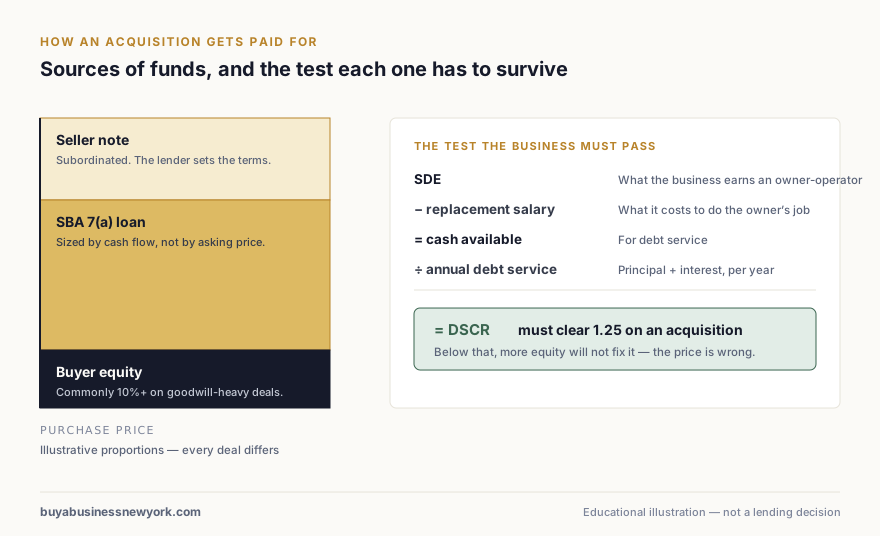
- Business cash-flow capacity: the lender\'s reconstructed SDE (or EBITDA) of the target, on which the loan\'s annual debt service must clear the SBA minimum (1.25:1 on an initial acquisition), plus a separate 1:1 global cash-flow test that reaches the buyer’s own obligations.
- Program-cap math: $5M max loan[1], $3.75M max SBA exposure, and a 25-yr max maturity on the real-property portion[2]. SBA guarantees up to 85% of loans of $150,000 or less and up to 75% above that[3] — note "up to", because the guarantee is a ceiling rather than a fixed rate.
Each is independent. Strong buyer capacity cannot rescue a business that doesn’t DSCR; strong business cash flow does not get you approved if the buyer has a 600 FICO and no liquidity; max loan math sets a hard ceiling against anything else.
The six-step underwriting model
Each step below is sourced to a primary SBA page. The steps run in order; failing one usually stops the file.
Step 1 — Is the target SBA-small?. Size standards
The business must meet SBA size standards at 13 CFR Part 121, which set employee-count or average-annual-receipts limits by NAICS code. Most owner-operated NY small businesses qualify comfortably; many mid-sized service businesses do too. If the target is on the line (e.g. a $30M-revenue regional services business), confirm the NAICS classification early — a wrong NAICS makes the deal ineligible for 7(a) at any loan size.
Step 2 — Are you personally eligible?. Buyer eligibility & credit
You must be creditworthy and demonstrate a reasonable ability to repay the loan. SBA used to screen 7(a) Small loan applications with a FICO Small Business Scoring Service (SBSS) Score, but discontinued it effective 1 March 2026 — applications no longer receive one [4] . Lenders now apply the commercial credit analysis they use for similarly sized non-SBA loans, so cutoffs are lender policy rather than a published SBA threshold. Every direct and indirect owner, and every SBA-required guarantor, must be a U.S. citizen or U.S. national with their principal residence in the United States, and none may be on a federal exclusion list. Green-card holders are no longer eligible: since 1 March 2026 SBA treats lawful permanent residents, conditional or unconditional, as ineligible persons for 7(a) and 504 loans[6], and SOP 50 10 8.1 carries the rule forward[5]. A buyer who does not qualify has to look at financing without an SBA loan.
Step 3 — How much of your own cash do you bring?. Buyer equity injection
There is no statutory minimum equity injection. The SBA’s SOP requires that the buyer’s equity injection be sufficient to demonstrate a personal financial stake and that post-closing working capital is adequate. SOP 50 10 8.1 sets the floor at 10% of total project cost for a first acquisition and states it cannot be reduced or eliminated. Lenders may require more — credit policy above the floor — depending on cash flow, buyer credit and collateral, so plan for 10% as a minimum rather than a target. The injected cash must be sourced (the lender traces where it came from); borrowed-down-payments on credit cards are not acceptable. Independent of the down payment, the lender also verifies post-closing liquidity - the business needs to operate after closing, not just to be bought.
Step 4 — How much debt can the business service?. Business cash-flow DSCR
For a change of ownership, SOP 50 10 8.1 sets debt service coverage by transaction type: 1.25:1 for an initial acquisition and an owner buyout, 1.15:1 for a business expansion, measured on the last fiscal year-end or the average of the last two, on a historical or adjusted basis, plus at least 1:1 on a global basis[5]. The lender must evaluate your post-closing projections but may not rely on them to meet the requirement, so a target whose history falls short cannot be rescued with a forecast. Anything above the SBA floor that a lender asks for is their own credit policy. The lender reconstructs SDE or EBITDA its own way - backing out add-backs they don’t accept (see our SDE page for the green/yellow/red add-back table) and applying a replacement-manager salary where appropriate. The broker’s SDE number is a starting point for the conversation, not the underwriting number. This is the single biggest source of pre-close deal-fatigue - the number the buyer thought was the deal basis is not the number the lender uses.
Step 5 — What secures the loan?. Collateral & guarantees
The SBA’s collateral policy is that lenders take collateral that is available, but lack of collateral alone cannot be the reason to decline an otherwise-qualifying loan - borrower character, cash flow, and equity injection matter more. Personal guarantees are required from any owner of 20% or more of the borrowing entity (and from owners of 5% or more if the lender determines their guarantee is necessary to support the loan). On a change-of-ownership deal, the seller’s business assets typically collateralize the loan, the buyer’s outside assets pledge only if needed, and the loan is structured so the business itself repays from its cash flow.
Step 6 — What can the loan pay for?. Closing & use of proceeds
Allowed 7(a) uses include acquiring/refinancing real estate, working capital, refinancing debt, machinery/equipment, furniture/fixtures/supplies, and - directly relevant to acquisition buyers - "changes of ownership (complete or partial)". Maturities run up to 25 years when real property is in the deal, otherwise up to 10 years (whichever is the shortest appropriate term given the borrower’s repayment ability). Variable-rate maximums are tiered: base +3.0% on >$350K, base +4.5% on $250K-$350K, base +6.0% on $50K-$250K, base +6.5% on <=$50K. Prepayment penalty of 5%/3%/1% applies in years 1/2/3 on loans with maturity >=15 years. Most 7(a) acquisition loans are blended with a working-capital piece so the post-close business is not cash-starved.
What 7(a) will NOT let you count
SBA 7(a) lenders reconstruct SDE their own way - accepting only "almost always accepted" add-backs and routinely backing out "one-time" items that you might have been confident about in your own diligence. Bring a copy of the broker’s SDE schedule to your lender meeting; expect a lower underwriting-SDE number than the asking-price multiple implies. The table below is what the lender will typically not accept; see our SDE vs. EBITDA page for the green/yellow/red version of the same table in income-statement form.
- Broker-supplied SDE at face value without reconstruction. Lenders reconstruct SDE their own way, generally accepting only the "almost always accepted" add-backs and pulling "one-time" items into the operating-expense category if they recurred in prior years.
- Seller-financing proceeds toward your equity injection. A 7(a) loan requires a genuine cash equity injection from the buyer. Standby debt is a limited injection source under SOP 50 10 8.1, which caps limited sources at half the required injection in aggregate — so a seller note can cover at most half, and the rest must be unborrowed cash or another unlimited source (the sources rules).
- "Projected" revenue in the lender's cash-flow reconstruction. Most 7(a) acquisition underwriting uses the trailing twelve months (TTM) actual cash flow, not the broker's forward-year projection. Sellers - and asset-based 7(a) lenders - do sometimes accept a partial "ongoing concern" projection, but the lender applies a haircut and the buyer's deal basis needs to be the TTM number.
- Cap-ex forecasts below historical norms without supporting documentation. If the seller has been under-investing in equipment to inflate SDE, the lender will notice when comparing historical capex to the broker's forward projection. Add the missing capex back into the operating-expense base; the DSCR math follows.
- Unverified personal expenses run through the business. Lenders ask for receipts for the largest personal add-backs. A $5K "personal auto" with no receipts becomes $0 in the lender's reconstruction. A $20K "personal travel" without general-ledger backup becomes $0.
What 7(a) WILL let you count (seller-side mechanics)
The honest version: 7(a) is not as restrictive as competitor pages imply. Sellers and buyers craft the LOI to make 7(a) underwriting work, and several seller-side mechanics are explicitly allowed under SBA SOP 50 10:
- Seller financing on standby as a secondary layer. Under SOP 50 10 8.1, effective 1 October 2026, full standby means no payments of principal or interest for the term of the 7(a) loan, documented on SBA Form 155 or the lender's equivalent with the note attached. Interest may accrue and be amortised once the 7(a) loan is paid in full, and seller debt structured alongside a change of ownership becomes eligible to be refinanced after 36 months in place and current. A note that is subordinated but not on full standby is still permitted as a financing layer — it simply does not count toward the equity injection, and total debt including it is capped at the business valuation amount. Terms are negotiated in the LOI and are not modifiable after the lender reviews the file.
- Working capital as an allowed use of the 7(a) loan proceeds. The full 7(a) loan can be structured as a single loan where a portion funds the purchase price and a portion funds post-closing working capital. Most acquisition loans are blended this way - the business needs operating cash after closing, not just to be bought.
- Refinancing of existing seller business debt as part of the package. If the business has seller-side debt that constrains its cash flow (e.g. equipment notes, working-capital lines), 7(a) can refinance that debt as part of the change-of-ownership transaction. The lender will require clear documentation of the existing debt terms.
- Real estate acquired with the business as an allowed use - with the longer 25-year maturity. If the deal includes the real property occupied by the business, that portion of the loan can be amortized over 25 years rather than 10 - a meaningful DSCR benefit. The standard 7(a) variant handles both real-property and non-real-property portions; you don't need a 504 unless you specifically want a 504's 50/40/10 structure with two loans.
Program caps, guarantees, rates - the numbers
All figures below are sourced to the SBA\'s own 7(a) terms and eligibility page. They are current as of the source page’s last-updated date; verify before you draw down a loan.
| Item | Value | Source |
|---|---|---|
| Max 7(a) loan amount | $5,000,000 | 7(a) overview / T&C |
| Max SBA exposure (guaranteed dollars) | $3,750,000 | 7(a) T&C |
| Guarantee on loans ≤ $150,000 | 85% | 7(a) T&C |
| Guarantee on loans > $150,000 | 75% | 7(a) T&C |
| Max maturity (real property portion) | 25 years | 7(a) T&C |
| Max maturity (non-real-property) | 10 years | 7(a) T&C |
| SBSS screen (7(a) Small) | Discontinued 1 Mar 2026 | Notice 5000-875701 |
| Variable-rate max > $350K | base rate + 3.0% | 7(a) T&C |
| Variable-rate max $250K-$350K | base rate + 4.5% | 7(a) T&C |
| Variable-rate max $50K-$250K | base rate + 6.0% | 7(a) T&C |
| Variable-rate max ≤ $50K | base rate + 6.5% | 7(a) T&C |
| Prepayment penalty (≥15-yr maturity) | 5% / 3% / 1% in years 1 / 2 / 3 | 7(a) T&C |
"T&C" = 7(a) Terms, conditions, and eligibility · "overview" = SBA 7(a) loans landing · "lender program" = SBA 7(a) lender program. Page last-updated dates vary; see the source registry entries for each.
Two NY-specific sidebars
Mortgage recording tax when the SBA loan is secured by real property
If part of the 7(a) loan is collateralized by NYS real property, the mortgage recorded against that property may be subject to NYS Mortgage Recording Tax. The New York State Tax Department publishes the rate structure on its mortgage recording tax page referenced in nys-tax-home; verify current rates with the county clerk in the jurisdiction of the property. The MRT is a closing cost that should be in your LOI’s "closing costs" allocation - it is not optional and it is not underwritten into the loan; it comes out of the buyer\'s equity injection or as a use-of-proceeds fee.
Foreign-entity authorization for out-of-state buyers
If you are an out-of-state buyer forming a new NY entity to acquire the target (or buying it through your existing out-of-state entity), the acquiring entity must be authorized to do business in New York through the NYS Department of State. This is a NYS Business Express filing at the entity-formation stage, notarized in the lending file, and the SBA\'s PLP lenders ask for it during the credit memo. If you skip it, the underwriting timeline slips; if you close without it and the entity is later found to be unauthorized, your ability to enforce contracts in NYS courts is impaired. Build this into the LOI’s "buyer-side" preparation list.
Run this in parallel with the NYS bulk-sale notice
The SBA underwriting timeline and the NYS bulk-sale notice timeline run in parallel during diligence. Form AU-196.10 (the buyer-side NYS bulk-sale notice) should be filed at least 10 days before closing, not at the beginning of underwriting - but you should know whether to expect Form AU-197.1 (release) or AU-196.2 (escrow) before the lender issues the commitment, because AU-196.2 will require an escrow arrangement the SBA lender must approve. See our NYS bulk-sale / successor liability page for the buyer-side mechanics.
Where to go next
- See the seller-side NYS tax exposure - NYS bulk-sale / successor liability
- Decide asset vs. entity structure - Asset vs. entity sale in New York
- Run buyer-side budget math - Affordability calculator
- Understand the lender\'s SDE reconstruction - SDE vs. EBITDA
Not sure your deal clears the 1.25 DSCR — or the global test?
Bring the broker’s SDE schedule, the LOI, and a recent personal financial statement to a free 20-minute call with Jason. We\'ll spot-check the lender-reconstruction math - your deal basis should be the lender\'s SDE number, not the broker\'s.
Frequently asked questions
What is the minimum down payment / equity injection for an SBA 7(a) loan buying a business?
There is no single statutory minimum; the SBA SOP requires that the buyer’s equity injection be sufficient to demonstrate a personal financial stake and that post-closing working capital is adequate. SOP 50 10 8.1 sets the minimum at 10% of total project cost for a first acquisition and states it cannot be reduced or eliminated. A lender may ask for more depending on the business’s cash flow, the buyer’s credit and liquidity, and the collateral available — that part is credit policy above the SBA floor, and it is the part that is negotiable. The cash injection must be sourced (the lender traces where the down payment came from), and 'borrowed down payments' on credit cards are not acceptable. Independent of the down payment, the lender also verifies post-closing liquidity — the business needs to operate after closing, not just be bought.
What credit score do I need for a 7(a) loan?
There is no longer an SBA-set score to hit. SBA discontinued the FICO Small Business Scoring Service (SBSS) Score for 7(a) Small loans effective 1 March 2026 — applications no longer receive an SBSS Score and SBA no longer screens with one. In its place lenders apply the same commercial credit analysis they use for similarly sized non-SBA loans, so the answer is now the lender's policy rather than a published threshold. Ask the lender what they require, and expect personal credit history, post-closing liquidity and the business's own cash flow to carry more weight than any single number.
What does SBA 7(a) mean by 'changes of ownership (complete or partial)'?
It is one of the SBA-allowed uses of 7(a) loan proceeds. A 'complete change of ownership' is a 100% buyout — the buyer purchases all of the equity of the seller’s entity or all of the assets of the seller’s business. A 'partial change of ownership' is a buy-in: the buyer purchases some but not all of the equity or assets. Partial changes of ownership are underwritten differently — the seller often retains a minority equity stake, the seller’s continuing role matters, and the seller-financing layer (if any) is structured to satisfy SBA subordination rules. Refer to SOP 50 10 (Lender and Development Company Loan Programs) for the lender-facing mechanics.
How does DSCR (debt-service coverage ratio) affect how much I can borrow?
The SBA’s underwriting convention is that the business’s available cash flow — typically the lender’s reconstructed SDE or EBITDA minus a replacement-manager salary where applicable — must cover the proposed loan’s annual debt service by at least 1.25:1 on an initial acquisition — the SOP 50 10 8.1 floor for a change of ownership, measured on the last fiscal year-end or a two-year average, and not something projections can meet — with a separate test requiring at least 1:1 on a global basis. A business expansion, where an existing business buys another, needs 1.15:1. Debt service there means principal and interest on all business debt including the new loan, not only the acquisition loan. Anything a lender asks above the SBA floor is credit policy. Lenders reconstruct SDE their own way, generally backing out add-backs they don’t accept; the broker’s SDE number is a starting point, not the underwriting number. A target generating $400K of lender-reconstructed cash flow at a 1.25 DSCR supports roughly $320K of annual debt service, which translates into a maximum loan amount that you can compute against the prevailing interest rate and amortization. See our affordability calculator for the buyer-side version of this math.
Does the SBA require collateral and a personal guarantee on a 7(a) acquisition loan?
Usually yes on both. The SBA’s collateral policy is that lenders take collateral that is available, but lack of collateral alone cannot be the reason to decline a loan that otherwise qualifies — the borrower’s character, cash flow, and equity injection matter more. Personal guarantees are required from any individual with direct or indirect ownership of 20% or more, and the SOP calls for an unlimited full guaranty — you guarantee the loan in full, not your ownership share of it. The spouse rule is not about community property, and New York buyers should not assume they are outside it: each spouse owning less than 20% must personally guarantee the loan in full once the combined ownership interest of both spouses and minor children reaches 20% or more. Even a non-owner spouse must sign the appropriate collateral documents, though their guaranty on jointly held collateral is limited to their interest in it. See the personal guarantee guide.
Can I use seller financing on top of the SBA 7(a) loan?
Often, yes — but read the standby terms before you promise anything. Under SOP 50 10 8.1, effective 1 October 2026, a seller note only counts toward your equity injection if it is on full standby, which means no payments of principal or interest for the term of the 7(a) loan — not for the first two years. Interest may accrue and amortise after the 7(a) loan is repaid in full, and seller debt becomes eligible to be refinanced once it has been in place and current for 36 months. A note on standby can also supply no more than half your required injection. This is a structural term in the LOI, not something that can be agreed after the lender reviews the file. See our LOI walkthrough page (planned) for the clause language.
Sources cited on this page
Every mutable number on this page — program caps, tax rules, thresholds, filing deadlines — traces to one of these primary sources. Rules change; check the source before you act on the number.
- 1 U.S. Small Business Administration. 7(a) loans. https://www.sba.gov/funding-programs/loans/7a-loans
- 2 U.S. Small Business Administration. 7(a) Terms, conditions, and eligibility. https://www.sba.gov/partners/lenders/7a-loan-program/terms-conditions-eligibility
- 3 U.S. Small Business Administration. 7(a) loan program (lender-facing). https://www.sba.gov/partners/lenders/7a-loan-program
- 4 U.S. Small Business Administration. Procedural Notice 5000-875701 — Sunset of SBSS Score for 7(a) Small Loans. https://www.sba.gov/document/procedural-notice-5000-875701-sunset-sbss-score-7a-small-loans
- 5 U.S. Small Business Administration. SOP 50 10 8.1 — Appendix 15: 7(a) Changes of Ownership. https://www.sba.gov/document/sop-50-10-lender-development-company-loan-programs
- 6 U.S. Small Business Administration. Procedural Notice 5000-876626 — Revised Applicant Ownership, Citizenship and Residency Requirements for 7(a) and 504 Loans. https://legacy.sba.gov/document/procedural-notice-5000-876626-revised-applicant-ownership-citizenship-residency-requirements-7a-504-loans
Educational only — not legal, tax, lending, or investment advice. Confirm specific rules, rates, and forms with the relevant New York State agency, attorney, CPA, lender, or insurer before acting. See the editorial policy and methodology for how sourcing and review work.