
SBA financing guide
SBA equity injection rules for buying a business
Most guidance online says the SBA requires "10% down." That is the right number attached to the wrong questions. Ten per cent of what, contributed by whom, and how much of it may be borrowed are three separate rules — and the answers changed in the SOP taking effect on 1 October 2026.
On this page14 sections
- Ten per cent of project cost, not of price
- The requirement depends on which of four transactions you are doing
- An Initial Acquisition must be a purchase of 100%
- Where the injection may come from — and the half rule
- Unlimited sources
- Limited sources — capped at half the injection
- What "full standby" actually requires
- The valuation is a ceiling on debt, not a formality
- The $3 million Quality of Earnings trigger
- The seller has to leave
- Seller earnouts are prohibited; buyer rebates are not
- A worked example
- Questions to put to a lender before you sign an LOI
- What this page does not tell you
Ten per cent of project cost, not of price
SOP 50 10 8.1 states that equity injections for change-of-ownership transactions are "based on the total project cost of the business… plus any additional use of proceeds that are included in the loan request" [1] . Owner Buyout transactions are the exception: there the requirement is based on the purchase price as reflected in the purchase and sale agreement.
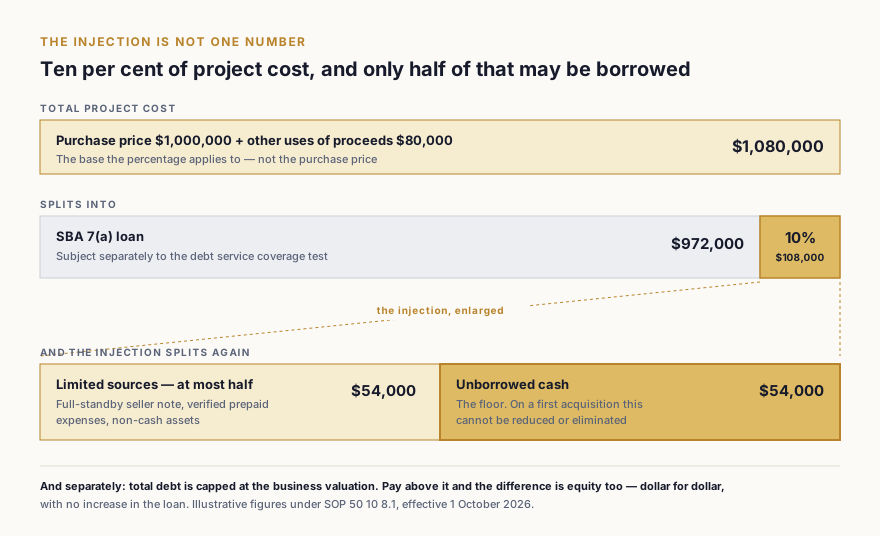
The distinction is not academic. If you are buying a business for $1,000,000 and the loan also funds $30,000 of closing costs and $50,000 of working capital, the project cost is $1,080,000 and the injection is $108,000 — not $100,000. Every additional use of proceeds you fold into the loan raises the cash you must bring.
The requirement depends on which of four transactions you are doing
Appendix 15 does not have one acquisition rule. It has four transaction types, and the type determines both the minimum and whether a lender has any discretion over it.
| Transaction type | Minimum injection | Can the lender reduce or eliminate it? |
|---|---|---|
| Initial Acquisition — a new majority or largest individual owner who was not previously employed by, or an owner of, the business | 10% | No. The SOP states it "cannot be reduced or eliminated." |
| Business Expansion — an existing operating business buys another in the same four-digit NAICS Industry Group | 10% | Yes, if the lender determines the borrower has sufficient liquidity and working capital to sustain operations after the transaction |
| Owner Buyout — a change to the ownership structure of the applicant itself, with no other entity acquired | 10% of purchase price | Yes, on the same liquidity and working-capital test |
| ESOP & Cooperative | 10% | Loans to purchase a controlling interest of at least 51% for an ESOP are not subject to the injection requirement at all |
Two conditions attach to any reduction or elimination on a Business Expansion or Owner Buyout. The applicant's balance sheet must not show a negative net worth as of the last fiscal year-end. And when the requirement is eliminated, the lender cannot include permanent working capital in that or any other 7(a) term loan request within 90 days — any working capital needed for the transaction has to come from existing cash or a line of credit [1] .
If you are a first-time buyer with no prior stake in the target, you are an Initial Acquisition. There is no discretion to argue for. That is worth knowing before you spend three weeks negotiating with a lender about it.
An Initial Acquisition must be a purchase of 100%
The buy-a-slice-now structure that buyers frequently propose — take 40% today, the balance in three years — is not an Initial Acquisition under this SOP. Initial Acquisitions may be financed where a buyer "is purchasing 100% of the ownership interest in the small business."
A partial purchase is an Owner Buyout, and Owner Buyout carries its own constraints: at least one member of original ownership must remain in place after the transaction and guarantee the loan, and individuals not currently employed by the business "may only acquire less than 50% of the total equity and may not become the largest direct or indirect shareholder" [1] . The SOP applies that limit to indirect interests held through holding companies, trusts, and partnerships, so an interposed entity does not solve it.
The practical translation: as an outside buyer you either take the whole business or you take a minority position you do not control. There is no SBA-financed middle.
Where the injection may come from — and the half rule
This is the part most summaries omit, and it is the part that decides whether a deal is doable. Appendix 15 splits injection sources into two classes.
Unlimited sources
- Cash that is not borrowed, whether on the business's balance sheet or from other sources.
- Cash from a personal loan to a guarantor where repayment can be demonstrated to come from a source other than the cash flow of the business. The SOP is explicit that the salary paid to the owner by the business does not qualify.
- Grants with no conditional repayment requirement, clawback, or other provision that could require repayment during the term of the 7(a) loan.
Limited sources — capped at half the injection
The SOP states that the following "whether individually or in the aggregate, may provide no more than half of the required Equity Injection":
- Standby debt, including a seller note on full standby.
- Non-borrowed cash, and personal-loan cash meeting the repayment-source test, appearing again in the limited list.
- Grants without repayment or clawback provisions during the life of the loan.
- Assets other than cash. An appraisal or other valuation by an independent third party is required if the fixed assets are valued above net book value — and the SOP says a valuation of fixed assets provided as part of a business valuation does not satisfy this.
- Eligible prepaid expenses the lender has verified with paid invoices, cancelled cheques, or bank statements. Expenses for education, advisory services, or fees paid to an Agent are not eligible prepaid expenses and are not equity.
- An equity investment not subject to an agreement to repay equity or make distributions to recover the investment before release of the guaranty. The SOP treats any investment carrying such an agreement — it names certain redeemable preferred stock — as debt, not equity.
So on a $1,080,000 project cost with a $108,000 requirement, at most $54,000 can come from a standby seller note. At least $54,000 has to be unborrowed cash or another unlimited source. A seller cannot finance your entire down payment. Any structure premised on that does not clear the SOP.
One narrow expansion exists. Where the sale price exceeds the value supported by the business valuation and QoE, additional limited sources may be used to bridge the gap — and the SOP requires that any such additional funds be on full standby. That is extra equity stacked above the 10%, not a way to enlarge the borrowable half of it.
What "full standby" actually requires
Debt counts as equity only on terms most sellers have not been asked for before:
- No payments of principal or interest for the term of the 7(a) loan.
- But interest may still accrue. The SOP provides that "The standby debt may accrue interest and may be added to the standby debt and amortized after the 7(a) loan is paid in full" [1] . This is the single most useful thing to tell a seller who has just heard "no payments" and stopped listening — the debt is deferred, not forgiven, and it can keep earning.
- The standby creditor subordinates. They must subordinate any lien rights in collateral to the lender’s rights, and take no action against the borrower or the collateral without the lender’s consent [1] . Not reduced payments. Not interest-only. None.
- SBA Form 155 or the lender's equivalent standby agreement, with a copy of the note attached and held in the credit file.
- The standby creditor must subordinate any lien rights in collateral to the lender's rights, and take no action against the borrower or the collateral without the lender's consent.
- The provider of standby debt may not take an equity investment in the business.
Interest is not forbidden — it may accrue, be added to the standby debt, and be amortised after the 7(a) loan is paid in full. On a ten-year 7(a) loan, that is a seller waiting a decade. Price that honestly when you propose it, and note that a note carrying stated interest still has to clear the IRS applicable federal rate to avoid imputed-interest treatment [2] .
Separately, seller debt structured alongside a 7(a) change of ownership "is eligible to be refinanced after it has been in place and current for 36 months." That is the earliest exit a standby seller has, and it is worth telling them at the negotiating table rather than after.
The valuation is a ceiling on debt, not a formality
Two provisions in Appendix 15 work together and are more restrictive than most buyers expect.
First: "The business valuation must support the Purchase Price… regardless of how the debt is structured. If the amount paid for the business exceeds the business valuation, the difference must be made up by equity."
Second: "The total debt eligible to support a change of ownership transaction (including seller debt that is not on full standby) is limited to the business valuation amount and must be supported by the Debt Service Coverage of the Applicant" [1] .
Overpay and you do not get a bigger loan — you write a bigger cheque, dollar for dollar. There is one detail worth knowing about how you write it: the SOP provides that "Additional Limited Equity Sources may be used when additional funds are required to supplement the purchase when the sales price exceeds the value supported by the Business Valuation and Quality of Earnings report", and that "any additional funds provided must be on full standby" [1] . So the gap above valuation can be bridged by a source that would normally be capped at half the injection — but only on full standby terms. Note also that the valuation must be requested by and prepared for the lender; the SOP says the lender may not use a business valuation prepared for the applicant or the seller. A valuation the broker commissioned is not the valuation that governs.
The independent Qualified Source must hold one of five credentials: ASA, CBA, ABV, CVA, or BCA, and must be independent of the loan production function, uninvolved in approving the transaction, and free of the appearance of a conflict.
A correction worth carrying: a great deal of guidance still online describes a $250,000 threshold below which a lender could rely on an internal business valuation. That threshold does not appear in SOP 50 10 8.1. This appendix requires financial due diligence on all change-of-ownership transactions. If an adviser tells you your $400,000 deal is too small to need an independent valuation, ask which SOP they are reading.
The $3 million Quality of Earnings trigger
For Business Expansion and Initial Acquisition transactions where the purchase price is $3,000,000 or more, the lender must obtain a Quality of Earnings report in addition to the business valuation. The SOP closes the obvious loophole directly: "The $3 million threshold is determined before the application of buyer equity, seller debt, or other financing sources." You cannot structure your way under it.
Owner Buyout and ESOP & Cooperative transactions are exempt, on the stated reasoning that existing owners retain operational knowledge and the transaction does not change the management or operating structure.
The QoE specification is unusually prescriptive, and it is worth reading if you are near the threshold because it tells you what the lender's analyst will be doing to the seller's numbers. It must be prepared for the lender — not by or for the borrower or seller — and it must include a Cash Proof: an analysis that reconstructs cash receipts and disbursements by reconciling bank statement data to the income statement and tax return for each period, performed on both a trailing-twelve-month basis and the last two fiscal years.
Critically, the earnings the QoE produces are the earnings the lender must use: "the Lender must use the earnings from the QoE in the Debt Service Coverage (DSC) determination." If that coverage does not support the valuation and the proposed debt structure, the loan amount must be reduced. Our QoE guide covers the analysis itself; the DSCR calculator lets you test the arithmetic before a lender does.
The seller has to leave
In a Business Expansion or Initial Acquisition, the SOP says the seller "may not remain as an officer, director, stockholder, or employee of the business." Where a transition period is genuinely needed, the business may contract with the seller as a consultant "for a period not to exceed 24 months (in aggregate, including any extensions)."
Two exceptions: an owner selling less than their entire percentage (which is an Owner Buyout — Partial Change), and an ESOP, equivalent trust, or cooperative acquiring 51% or more. When buying a business owned by an ESOP, employees who are members of the ESOP Trust may remain employees after the sale.
If your value case depends on the founder staying three years, an SBA-financed acquisition is the wrong instrument. Reprice the deal around a 24-month handover or find another lender.
Seller earnouts are prohibited; buyer rebates are not
The SOP is one sentence on this and it is unambiguous: "Seller earnouts are prohibited; however, buyer rebates based on business performance are allowed because this is a benefit to the Borrower."
The asymmetry follows the credit logic. An earnout adds contingent obligation to a borrower the SBA has just underwritten; a rebate reduces it. But the rebate carries a condition — if the borrower receives rebate funds, the proceeds must be applied to pay down the principal balance of the 7(a) loan that funded the change of ownership. It is not free cash to the buyer. The SOP does note, under 13 CFR § 120.223, that applying seller rebate payments to principal does not trigger a subsidy recoupment fee.
If you have negotiated a performance-contingent price on an SBA deal, it has to be built as a downward rebate to the buyer, not an upward earnout to the seller. Our earnout guide covers the structures that survive this.
A worked example
Initial Acquisition of a New York service business. Agreed price $1,000,000. The loan also funds $30,000 in closing costs and fees and $50,000 of working capital.
| Line | Amount | Why |
|---|---|---|
| Business purchase price | $1,000,000 | Excludes owner-occupied commercial real estate, which is valued separately |
| Other uses of proceeds | $80,000 | Closing costs and working capital included in the loan request |
| Total project cost | $1,080,000 | The base the injection is calculated on |
| Required equity injection at 10% | $108,000 | Cannot be reduced or eliminated on an Initial Acquisition |
| Maximum from limited sources | $54,000 | Standby seller note, verified prepaid expenses, non-cash assets — capped at half |
| Minimum unborrowed cash | $54,000 | The floor. No structure reduces it on this transaction type |
| 7(a) loan amount | $972,000 | Subject to the valuation ceiling and the DSCR test |
The equity injection planner runs this arithmetic on your own figures, including the half cap and the valuation ceiling below.
Now change one fact. The independent valuation comes back at $940,000 against a $1,000,000 price. The $60,000 gap must be made up by equity, and total debt is capped at the valuation amount. The buyer's cash requirement rises; the loan does not. This is the single most common way a deal that looked financed stops being financed.
And the injection is not the cheque. Add legal fees, the buyer's own diligence costs, licence and permit costs, and post-closing reserves. Our cash-to-close calculator builds the real number; how much business can I afford runs it in reverse from the cash you actually hold.
Questions to put to a lender before you sign an LOI
- Which of the four transaction types is this, in your view, and why?
- What total project cost are you calculating the injection on — and what is in it besides the purchase price?
- How much of my injection are you prepared to accept from limited sources, and what documentation do you need for each?
- Will you accept a full-standby seller note for the limited half, and will you use SBA Form 155 or your own form?
- Who commissions the business valuation, when, and at whose cost? (It must be prepared for you, the lender.)
- Is this deal over the $3,000,000 QoE threshold on purchase price before financing?
- If the valuation lands below the purchase price, what happens to my loan amount and my cash requirement?
- Is my application going in before or after 1 October 2026 — and which SOP governs it?
That last question is not pedantry. SOP 50 10 8.1 is effective from 1 October 2026, and the great majority of guidance published online describes the rules that preceded it. Whichever set governs your file, make the lender name it.
What this page does not tell you
This is a reading of Appendix 15 of a published federal SOP, not advice on your transaction. Lenders may impose requirements stricter than the SOP and routinely do — the SOP sets a floor for SBA's guaranty, not a ceiling on a bank's credit policy. Delegated lenders exercise judgment within it. Nothing here addresses the 504 programme, which handles real estate and equipment differently and is compared in our 7(a) versus 504 guide. And no page substitutes for your own counsel and accountant reading your own documents.
Frequently asked questions
How much do I actually have to put down on an SBA 7(a) business acquisition?
For an Initial Acquisition — a buyer who did not previously own or work in the business — SOP 50 10 8.1 sets the minimum equity injection at 10% of total project cost, and states that it cannot be reduced or eliminated. Total project cost is the purchase price plus other uses of proceeds in the loan request, such as closing costs and working capital, so 10% of project cost is more dollars than 10% of the purchase price.
Can a seller note cover my entire down payment?
No. Standby debt is a Limited Equity Injection Source, and SOP 50 10 8.1 states those sources may provide no more than half of the required equity injection, individually or in the aggregate. On a 10% requirement, a full-standby seller note can therefore cover at most 5% of project cost. The other half must come from an unlimited source such as unborrowed cash.
What makes a seller note count as equity rather than debt?
Full standby: no payments of principal or interest for the term of the 7(a) loan. The SOP requires SBA Form 155 or the lender's equivalent standby agreement with a copy of the note attached, and requires the standby creditor to subordinate lien rights and take no action against the borrower or collateral without the lender's consent. A note on partial standby, or one that pays interest currently, is debt.
Do I need a business valuation on a small acquisition?
Under SOP 50 10 8.1, yes. The appendix requires financial due diligence on all change-of-ownership transactions and requires the business valuation to be requested by and prepared for the lender by an independent Qualified Source. The older $250,000 threshold, below which a lender could rely on an internal valuation, does not appear in this SOP. Much third-party guidance online still describes that threshold.
When is a Quality of Earnings report mandatory?
For Business Expansion and Initial Acquisition transactions where the purchase price is $3,000,000 or more. The SOP states the threshold is determined before the application of buyer equity, seller debt, or other financing sources, so structuring cannot get you under it. Owner Buyout and ESOP & Cooperative transactions are exempt.
Can I buy 40% of a business now and the rest later with SBA financing?
Not as a first-time outside buyer. SOP 50 10 8.1 finances an Initial Acquisition only where the buyer is purchasing 100% of the ownership interest. Partial purchases fall under Owner Buyout, where at least one member of original ownership must remain and guarantee the loan, and someone not currently employed by the business may acquire only less than 50% and may not become the largest shareholder.
Can the seller stay on after closing?
Only briefly, and only as a contractor. In a Business Expansion or Initial Acquisition the seller may not remain as an officer, director, stockholder, or employee. If a transition period is needed, the business may contract with the seller as a consultant for a period not to exceed 24 months in aggregate, including extensions. Owner Buyout and ESOP transactions are structured differently.
Are earnouts allowed on an SBA-financed acquisition?
Seller earnouts are prohibited. Buyer rebates based on business performance are allowed, because they benefit the borrower — but if the borrower receives rebate funds, the SOP requires the proceeds be applied to pay down the principal of the 7(a) loan that funded the change of ownership.
Sources cited on this page
Every mutable number on this page — program caps, tax rules, thresholds, filing deadlines — traces to one of these primary sources. Rules change; check the source before you act on the number.
- 1 U.S. Small Business Administration. SOP 50 10 8.1 — Appendix 15: 7(a) Changes of Ownership. https://www.sba.gov/document/sop-50-10-lender-development-company-loan-programs
- 2 Internal Revenue Service. Applicable Federal Rates. https://www.irs.gov/applicable-federal-rates
Educational only — not legal, tax, lending, or investment advice. Confirm specific rules, rates, and forms with the relevant New York State agency, attorney, CPA, lender, or insurer before acting. See the editorial policy and methodology for how sourcing and review work.