
Cycle 2 guide
NYS bulk-sale & successor liability when you buy a business
The New York bulk-sale rule is the single most under-explained tax exposure in a business acquisition. If you buy a business’s assets and pay the seller without filing Form AU-196.10 first, you can be held personally liable for the seller’s unpaid sales and use taxes — up to the purchase price or fair-market value of the assets, whichever is greater[1].
On this page9 sections
- The 30-second version
- What counts as a bulk sale in New York
- The buyer’s 7-step workflow
- The seller’s 6-step workflow
- Don’t conflate four different NYS tax exposures
- What an LOI should contain for bulk-sale protection
- The asset-vs-entity trap, briefly
- Where to go next
- If your LOI doesn’t yet have an AU-196.10 closing condition, you may be taking the seller’s sales-tax exposure on personally.
The 30-second version
If you are buying the assets of a New York business that is required to collect sales tax:
- File Form AU-196.10 with the NYS Tax Department’s Bulk Sales Unit at least 10 days before paying for or taking possession of any business assets — whichever happens first[1].
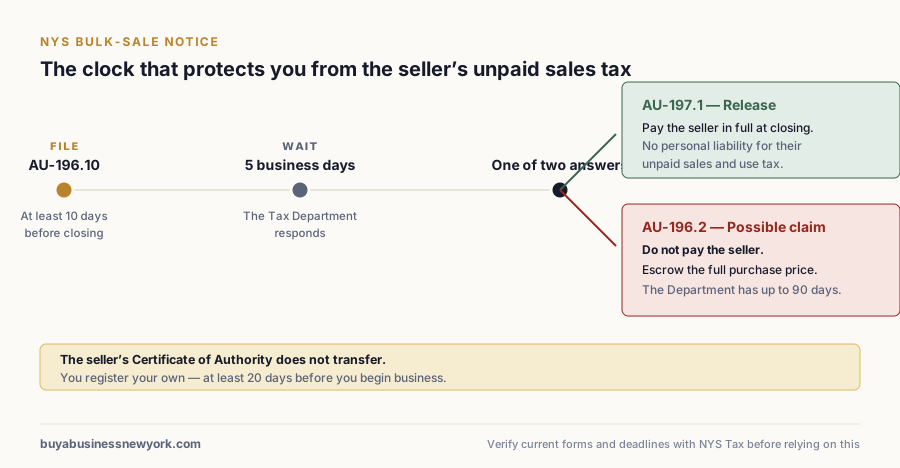
- The Tax Department has 5 business days from receipt to respond with either Form AU-197.1 (release — pay seller in full) or Form AU-196.2 (claim — escrow the purchase price and wait up to 90 days for the dept to compute liability)[1].
- The seller’s Certificate of Authority is NOT transferable — you must apply for your own via NYS Business Express at least 20 days before you begin business[2].
- The seller must give every prospective buyer Form TP-153, but your obligations apply whether or not the seller actually delivers it[1].
- None of this applies to a stock/entity purchase — but the seller’s sales-tax liability then travels with the entity you bought, and there is no notice-and-release mechanism to protect you. See our asset vs. entity sale page.
What counts as a bulk sale in New York
A bulk sale under NYS Tax Law is the sale, transfer, or assignment of business assets, in whole or in part, by a person required to collect sales tax. Business assets means any assets directly related to the conduct of a business, including tangible personal property, real property, and intangible assets such as goodwill[1]. Retail sales to customers in the ordinary course of business are not bulk sales.
The Tax Department’s own bulletin (TB-ST-70) spells out examples — most of which a buyer would not intuitively guess:
- A retiring contractor sells all his tools and equipment to another contractor.
- A restaurant that is closing sells fixtures and equipment to a person opening a new restaurant.
- Corporation A (required to collect sales tax) sells its business assets to Corporation B for $5,000.
- Corporation C transfers all of its business assets to Corporation D in exchange for stock in Corporation D.
- A sole proprietor incorporates her business and transfers her business assets to the new corporation[1].
What is not a bulk sale — and this is the structural decision that drives the whole page:
- Corporation A purchases all the issued and outstanding stock of Corporation B (required to collect sales tax). Corporation A and Corporation B continue to exist as separate legal entities. Since the business assets of Corporation B have not been transferred in connection with the sale of its stock, this is not a bulk sale. — NYS Tax Bulletin TB-ST-70[1]
In plain English: an entity purchase sidesteps the bulk-sale notice process entirely — but you inherit the seller’s unpaid sales tax as a liability of the entity you just bought, with no notice-and-release protection. The trade-off is structural, and is the major subject of our asset-vs-entity sale in New York guide.
The buyer’s 7-step workflow
Every step below is sourced to the NYS Tax Department’s bulk-sales bulletin and the related forms. The numbers (10 days, 5 business days, 90 days, 20 days, 30 days) are statutory — they are not negotiable and they are not suggestions.
1. Demand TP-153 from the seller. The seller is required to give every prospective purchaser Form TP-153, Notice to Prospective Purchasers of a Business or Business Assets. Receiving it does not protect you — but a seller who refuses to provide it is a signal. Your obligations under the bulk-sale rule apply whether or not the seller actually delivers TP-153.
2. File Form AU-196.10 at least 10 days before closing. File Form AU-196.10, Notification of Sale, Transfer, or Assignment in Bulk, with the NYS Tax Department's Bulk Sales Unit of the Audit Division in Albany. Use registered mail, certified mail with return receipt, or hand-delivery — other methods are not effective until the Tax Department actually receives the form, and the burden of proving receipt is on you. The 10-day clock runs to the earlier of "paying for" or "taking possession of" the assets.
3. Wait up to 5 business days for the Tax Department response. Within 5 business days after receipt, the Tax Department will issue either Form AU-197.1 (Release — seller has no unpaid sales tax and no review/audit is needed) or Form AU-196.2 (Notice of Claim — seller owes unpaid tax, is scheduled for a review, or is under audit).
4. If AU-197.1: pay seller in full at closing. A Form AU-197.1 release means you may pay the seller the full purchase price at closing without personal liability for the seller's unpaid sales and use taxes. Caution: the assets may still be subject to Tax Department liens if there are outstanding warrants or judgments against the seller — the release is not a lien release. A UCC-1 and NYS Tax Dept lien search at closing is still worthwhile.
5. If AU-196.2: escrow the full purchase price. Do not pay the seller. Place the full purchase price into an escrow account. The Tax Department has 90 days from receiving your AU-196.10 to notify you of the amount of sales tax due. When notified, pay the Tax Department out of escrow up to the purchase price or the fair market value of the assets, whichever is greater; release the remainder to the seller. The buyer's liability to the seller for the sale is then satisfied.
6. Apply for your own Certificate of Authority. The seller's Certificate of Authority is NOT transferable. If you intend to make taxable sales, apply for a new Certificate of Authority through NYS Business Express at least 20 days before beginning business. If you are changing the form of the entity (e.g. buying into an existing structure and converting), the seller must also surrender or destroy their existing Certificate.
7. Pay sales tax on the tangible personal property you bought. The buyer is responsible for the sales tax due on tangible personal property purchased in the bulk sale. This may be paid to the seller (to be remitted with the seller's final return) or paid directly to the Tax Department. Sales tax is NOT imposed on the sale of inventory acquired for resale, real property, or intangible assets such as goodwill.
Two practical cautions: (1) File a revised Form AU-196.10 if any information changes — write "Revised" at the top. A common mistake is leaving the scheduled closing date unchanged when the deal slips by two weeks. (2) Even after receiving Form AU-197.1, the assets you bought may still be subject to Tax Department liens if there are outstanding warrants or judgments against the seller for past unpaid taxes[1]. An AU-197.1 release is not a lien release. Run a UCC-1 search at the NYS Department of State and a Tax Department warrant search before closing regardless.
The seller’s 6-step workflow
The seller’s obligations run in parallel and most must be initiated before closing. If you are buying through a broker, the broker usually drives the seller-side checklist — but the seller is the legally responsible party.
1. Give every prospective buyer Form TP-153. Form TP-153, Notice to Prospective Purchasers of a Business or Business Assets, outlines the buyer's bulk-sale responsibilities. The seller is required to deliver this to every prospective purchaser. Failing to do so does not relieve the buyer of bulk-sale obligations or potential bulk-sale liability — but it is a clear compliance step the seller cannot skip.
2. Pre-clear your sales tax account. A seller considering a sale can contact the NYS Tax Department for a review of its sales tax account to determine if there are delinquent returns or unpaid sales tax. Resolving outstanding liabilities in advance shortens the bulk-sale window the buyer will go through and reduces the risk of an AU-196.2 (claim) being issued instead of an AU-197.1 (release).
3. Surrender or destroy your Certificate of Authority. A Certificate of Authority is NOT transferable. When you sell, transfer, or assign your business (or change the form of your business), you must surrender or destroy your Certificate and file a final sales tax return within 20 days of ceasing business.
4. File a final sales tax return. A final return covering the period through the last day of business must be filed within 20 days after the sale, transfer, or change in business form. Report sales, sales tax collected, use tax owed, and the sale itself (date, sale price, purchaser information). Any sales tax due on the sale of your tangible personal property assets is remitted with this final return.
5. File Form NYS-45 (Unemployment Insurance). If you had employees, file a final Form NYS-45, Quarterly Combined Withholding, Wage Reporting and Unemployment Insurance Return within 30 days of ceasing wages. Mark on line 23 whether you sold all or part of the business — this triggers the UI registration transfer mechanics at the Department of Labor.
6. If you are an NY corporation, plan for TR-125 (voluntary dissolution). On an entity sale, the NYS Tax Department must consent to the voluntary dissolution of a NYS corporation (Form TR-125) before the Department of State will process the dissolution. Out-of-state (foreign) corporations surrendering NYS authority use Form TR-199. Both processes take time and should be initiated before closing, not after.
Don’t conflate four different NYS tax exposures
This is where most competitor page explanations fail. Sales-tax successor liability is one of four separate NYS tax exposures that can travel with a business acquisition. They have different mechanical triggers, different caps, and different mitigations. Conflating them is the single most common error in the SERP.
| Exposure | Applies to | How it travels | Cap | Mitigation |
|---|---|---|---|---|
| Sales-tax successor liability | Asset sales only | Statutory on the buyer unless AU-196.10 is filed and AU-197.1 is received | Up to purchase price or fair market value of assets, whichever is greater | File AU-196.10 at least 10 days before payment/possession; escrow if AU-196.2 received |
| Withholding-tax exposure | Entity sales (the entity retains the liability) | Travels with the entity you bought | Full unpaid amount; no notice-and-release mechanism | Indemnification clauses in the purchase agreement; escrow at closing for known exposures |
| Unemployment-insurance registration transfer | Either structure if you continue the same business | NYS-100 registration; NYS-45 line 23 flag from seller | UI contribution-ratio experience rating can transfer to the buyer | NYS DOL notification; UI rate verification in diligence |
| Workers' comp / DB / PFL coverage continuity | Either structure if employees continue | Seller's WC policy does NOT transfer; buyer must carry coverage on day one | Statutory penalties and uncovered-claim exposure | Bind WC/DB/PFL before closing; CE-200 exemption flow only if no employees |
The mix-up matters in practice: a buyer who has filed AU-196.10, received AU-197.1, and closed the purchase may still discover post-close that the entity they bought was behind on withholding-tax remittances (entity sale) or that the seller’s UI experience rating transferred with them through NYS-100 (either structure). WC / DB / PFL coverage in force on day one is universally required and is not solved by either bulk-sale or asset-vs-entity structuring.
What an LOI should contain for bulk-sale protection
If your Letter of Intent does not yet have these as closing conditions, the seller’s unpaid sales tax is your unpaid sales tax on the day you fund:
- Seller-side: Delivery of Form TP-153 to all prospective buyers (sign of good faith; not a buyer protection).
- Buyer-side: Buyer has filed Form AU-196.10 and provided seller with a copy of the filed form and return receipt.
- Closing condition: Either receipt of Form AU-197.1 (release) OR an escrow arrangement sufficient to hold the full purchase price for the 90-day AU-196.2 window.
- Indemnification: Seller-side indemnity for any post-closing Tax Department claim unpaid-sales-tax exposure that survives the bulk-sale release.
- Survival: Tax indemnities should survive the closing for at least the NYS Tax Law limitations period — usually at least three years from the final return filing.
For the broader LOI mechanics — including asset-vs-entity structure as a condition and how an SBA 7(a) underwriting timeline interacts with the bulk-sale window — see our LOI walkthrough page (planned).
The asset-vs-entity trap, briefly
Most generic bulk-sale content stops at "asset sales trigger bulk sale." That is true, but it leaves the buyer confused about whether to use an entity purchase instead. The honest version is: an entity purchase sidesteps the bulk-sale notice process but does not protect you from the seller’s unpaid sales tax — it removes the notice-and-release mechanism. In an asset purchase, the buyer can derive certainty by filing AU-196.10. In an entity purchase, the buyer’s only protection is the indemnification clauses in the purchase agreement — and an escrow holdback at closing for known and unknown exposures.
The choice is structural and depends on (1) how clean the seller’s tax account is (run a voluntary Tax Department pre-clearance review on the seller side to check), (2) whether the deal is being financed with an SBA 7(a) acquisition loan (lender preferences often drive structure), (3) whether the seller’s entity owns real property (which triggers the NYS Real Property Transfer Tax controlling-interest test, even in a stock sale), and (4) whether you want the seller’s contracts, licenses, and permits to transfer with the entity. The full trade-off matrix is on our asset vs. entity sale in New York page.
Where to go next
- Decide asset vs. entity structure — Asset vs. entity sale in New York
- Finance the deal — SBA 7(a) acquisition loan underwriting
- Run the seller-side workflow alongside — Due diligence checklist
- See the whole process — How to buy a business in New York
If your LOI doesn’t yet have an AU-196.10 closing condition, you may be taking the seller’s sales-tax exposure on personally.
A free 20-minute call with Jason will at minimum tell you whether your LOI’s structure and closing conditions protect you against NYS bulk-sale successor liability — and whether your financing timeline gives the Tax Department’s 5-business-day response window time to clear.
Frequently asked questions
What happens if I just pay the seller and skip the AU-196.10 filing?
You may be held personally liable for any unpaid sales and use taxes the seller owes to New York State at the time of the sale — up to the purchase price or fair market value of the assets, whichever is greater. This liability is statutory and does not depend on whether the seller disclosed the exposure. The bulk-sale notice process exists precisely to protect the buyer; skipping it means you take the seller’s sales-tax exposure on personally.
Does the seller giving me TP-153 protect me?
No. Form TP-153 is the seller’s notice to you that the bulk-sale rules exist. The buyer’s protection comes from filing Form AU-196.10 with the NYS Tax Department at least 10 days before paying for or taking possession of the assets — not from receiving TP-153. The Tax Department is clear that even if the seller fails to give you TP-153, your obligations and potential bulk-sale liability are unchanged.
I received Form AU-197.1 — am I safe to close?
Released from sales-tax successor liability for the seller’s unpaid sales and use taxes — yes. But you may still be exposed to: (1) outstanding Tax Department warrants or judgments against the seller that attach as liens on the assets you bought, (2) withholding tax exposure if your deal is structured as an entity sale rather than an asset sale, (3) unemployment-insurance registration transfer if you’re continuing the same business under the same entity. AU-197.1 narrow-solves exactly one of these.
I received Form AU-196.2 — do I lose my deal?
Usually not, but you will likely close later than planned. You should escrow the full purchase price and wait for the Tax Department to compute the seller’s unpaid sales tax. The Department has 90 days from receiving your Form AU-196.10 to send you the amount due. Once that amount is paid out of escrow (up to the purchase price or fair market value of the assets, whichever is greater), the remaining balance can be released to the seller. Many LOIs build in a bulk-sale closing condition for exactly this scenario.
Does this apply if I’m buying the LLC or the corporation, not the assets?
No — and this is the single most important structural decision for sales-tax exposure. The NYS bulk-sale rule applies to the sale, transfer, or assignment of business assets. It explicitly does NOT apply when one entity purchases all of the issued and outstanding stock of another entity that is required to collect sales tax and the two entities continue to exist as separate legal entities. In an entity purchase, you inherit the seller’s unpaid sales tax as a liability of the entity you bought — which is in some ways worse, because there is no notice-and-release mechanism to protect you. See our asset-vs-entity page for the broader trade-off.
Where do I file Form AU-196.10?
With the NYS Tax Department’s Bulk Sales Unit of the Audit Division in Albany, by registered mail, by certified mail with return receipt, or by hand-delivery. Other delivery methods (regular mail, courier, fax, online portal) are not effective until the date the Tax Department actually receives the form — and the burden of proving receipt is on the buyer. The form number and mailing address are published on the Tax Department’s bulk-sales page; verify both before sending.
Sources cited on this page
Every mutable number on this page — program caps, tax rules, thresholds, filing deadlines — traces to one of these primary sources. Rules change; check the source before you act on the number.
- 1 NYS Department of Taxation and Finance. Bulk Sales (Tax Bulletin TB-ST-70). https://www.tax.ny.gov/pubs_and_bulls/tg_bulletins/st/bulk_sales.htm
- 2 NYS Department of Taxation and Finance. Amending or Surrendering a Certificate of Authority (Tax Bulletin TB-ST-25). https://www.tax.ny.gov/pubs_and_bulls/tg_bulletins/st/amending_or_surrendering_a_certificate_of_authority.htm
Educational only — not legal, tax, lending, or investment advice. Confirm specific rules, rates, and forms with the relevant New York State agency, attorney, CPA, lender, or insurer before acting. See the editorial policy and methodology for how sourcing and review work.