
Licensing guide
Food service permits outside New York City
Our guide to the New York City food permit says plainly that it does not generalise beyond the five boroughs. This is the other 57 counties — where the structure of the answer is the same everywhere and the detail is different in every one of them.
On this page7 sections
Who actually issues the permit
NYSDOH puts it in one sentence: "Permits are issued by the local health department responsible for the area where the food service establishment is located" [1] .
The State's role is different from what buyers assume. Its Food Protection Program "provides guidance and assistance to county and city health departments and State District Offices which in turn permit and inspect food service establishments" [2] . So the State writes the standards and advises; somebody local grants the permit and turns up to inspect.
| Where the business is | Who permits it |
|---|---|
| Most of New York State | The county health department for that county |
| A few cities with their own health departments | The city health department |
| Counties without their own health department | A NYSDOH State District Office |
| The five boroughs of New York City | NYC DOHMH under the City Health Code — a different regime entirely, covered in our NYC food permit guide |
The practical consequence is that there is no single upstate answer to give you, and any page that offers one is guessing. What generalises is the structure and the questions. The answers come from your department.
Part 14 is the floor, not the answer
Part 14 of the State Sanitary Code, maintained by the Bureau of Community Environmental Health and Food Protection, sets the statewide standards [1] :
| Subpart | Covers |
|---|---|
| 14-1 | Food service establishments — sit-down restaurants, takeaway, schools. The one most acquisitions fall under [3] |
| 14-2 | Temporary food service establishments — fairs and community events |
| 14-4 | Mobile food service establishments and pushcarts |
| 14-5 | Vending machines |
And then the sentence that matters most for diligence: "Some local health departments may have their own regulations in addition to the Subparts" [1] .
So reading Part 14 tells you the minimum standard the business will be inspected against. It does not tell you what your county adds. A buyer who researches the state code and stops has done half the work, and the missing half is the half that varies.
The sequencing trap
Insurance comes before the permit, not after. NYSDOH states that food service operators "must be in compliance with New York State Workers' Compensation and Paid Family Leave Benefits Insurance Requirements before a permit to operate will be issued" [1] . A buyer who plans to arrange cover in the first week after closing has the order wrong: no cover means no permit, and no permit means you cannot lawfully open the doors you just paid for.
This is easy to fix and expensive to discover late. Get the coverage bound to take effect on the closing date, get the certificates in the acquiring entity's name, and have them ready to file with the permit application rather than after it. Our experience rating guide covers the wider employment set-up that has to be right from day one [4] .
Assume the permit does not transfer
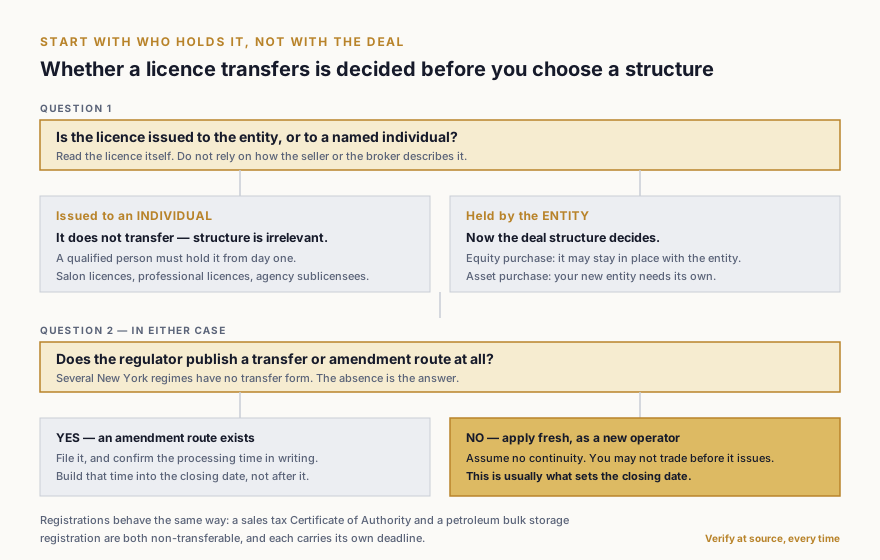
A food service permit is issued to an operator for a specific establishment. The consistent New York pattern — across occupational licences, liquor licences and the New York City food permit alike — is that such permits do not follow a sale, and the burden is on the buyer to have the issuing office say otherwise.
Because the issuing office here is local rather than statewide, this is genuinely a question you have to ask yours. What we can tell you is what to ask, and that a new permit usually means a review or inspection against current standards. That is the risk worth understanding: an established kitchen may have been operating for years under arrangements that would not be approved today, and a change of ownership can be the moment that catches up with the site.
How this differs from New York City
Inside the five boroughs, the City Health Code applies and contains a provision with no direct equivalent in the state framework: the Commissioner shall not issue a new permit based on a change of ownership where records show the seller's outstanding uncorrected violations or unpaid fines, absent a three-part arm's-length proof [5] . That is set out in our NYC guide.
Outside the city there is no single equivalent rule to point you at — which cuts both ways. Your department may be more relaxed about a seller's violation history, or it may have its own local provision that is stricter. The absence of a statewide rule is not the absence of a rule. It means you have to find out.
Eight questions for your health department
Ask these in writing, before the LOI if you can, and get the answers in writing too. The department is normally willing; buyers just rarely ask.
- Which authority permits this address — county, city, or State District Office?
- Does the existing permit transfer on a change of ownership, or must I apply for a new one?
- If a new permit: what is the current processing time, and does it require plan review, an inspection, or both?
- Will the premises be assessed against current standards, and is there anything in the existing set-up that would not be approved today?
- What is this establishment's inspection and violation history, and does any of it affect a new application?
- Are there local regulations beyond Part 14 that apply here?
- What must be in place before the permit issues — beyond workers' compensation and Paid Family Leave cover?
- Is a food protection certificate or manager certification required, and for whom?
Then make it a closing condition. Either your permit is issued before closing, or you have written confirmation of the route and the timetable. Closing first and applying afterwards means owning a restaurant you cannot open.
Scope and limits
This describes the framework outside New York City as NYSDOH publishes it. It deliberately does not give county-by-county detail: there are 57 counties outside the five boroughs, local departments may add their own regulations, and a page asserting specifics for all of them would be wrong somewhere. Where a specific county's rules are established and material, we will publish them separately and say which county they apply to.
Nothing here is legal advice, and a food business acquisition typically involves a liquor licence, a lease assignment and a bulk-sale filing on their own timetables as well. Sequence them together, not one at a time.
Frequently asked questions
Who issues a food service permit outside New York City?
The local health department for the area where the establishment is located. NYSDOH is explicit: "Permits are issued by the local health department responsible for the area where the food service establishment is located." In practice that is a county health department in most of the state, a city health department in a few places, and a State District Office where a county has no health department of its own.
Does the seller's permit transfer to me?
Treat it as no until the issuing department tells you otherwise in writing. A permit is issued to an operator for a specific establishment, and the general New York pattern is that it does not follow a sale. Because the issuing authority is local, this is one of the few questions on a New York acquisition that genuinely has 50-odd different offices to ask — so ask early, in writing, and ask yours.
What is Part 14?
Part 14 of the State Sanitary Code, maintained by NYSDOH's Bureau of Community Environmental Health and Food Protection. Subpart 14-1 covers food service establishments — sit-down and takeaway restaurants and schools; 14-2 temporary establishments at fairs and events; 14-4 mobile establishments and pushcarts; 14-5 vending machines. It sets the statewide floor.
Can my county add rules on top?
Yes, and this is the part buyers miss. NYSDOH says plainly that "some local health departments may have their own regulations in addition to" the state subparts. So Part 14 tells you the floor, not the answer. The answer is Part 14 plus whatever your county has layered on it.
What has to be in place before the permit issues?
Workers' compensation and Paid Family Leave coverage. NYSDOH states that food service operators "must be in compliance with New York State Workers' Compensation and Paid Family Leave Benefits Insurance Requirements before a permit to operate will be issued." That is a sequencing trap: a buyer planning to sort insurance in the first week after closing cannot get the permit, and without the permit cannot lawfully operate.
How is this different from New York City?
Materially. Inside the five boroughs the NYC Health Code governs, and it contains a provision with no direct equivalent here: the Commissioner shall not issue a new permit on a change of ownership where records show the seller's outstanding violations or unpaid fines, absent arm's-length proof. Outside the city, you are dealing with your local department's own rules — which may be more or less demanding, and which you have to actually read.
Does a change of ownership need a new inspection?
Commonly yes, and it is worth budgeting time for. A new permit generally means a plan review or an inspection against current standards — which can surface requirements the existing operation was grandfathered past. That is a capital risk, not just a delay, and it is the reason to establish the position before you sign rather than after.
Sources cited on this page
Every mutable number on this page — program caps, tax rules, thresholds, filing deadlines — traces to one of these primary sources. Rules change; check the source before you act on the number.
- 1 New York State Department of Health. Food Safety — Regulations & Permit Requirements. https://www.health.ny.gov/environmental/indoors/food_safety/regs.htm
- 2 New York State Department of Health. Food Safety — Bureau of Community Environmental Health and Food Protection. https://www.health.ny.gov/environmental/indoors/food_safety/
- 3 New York Codes, Rules and Regulations. 10 NYCRR Subpart 14-1 — Food Service Establishments. https://regs.health.ny.gov/content/subpart-14-1-food-service-establishments
- 4 NYS Workers' Compensation Board. Employers' coverage requirements. https://www.wcb.ny.gov/content/main/Employers/Employers.jsp
- 5 NYC Department of Health and Mental Hygiene. New York City Health Code, Article 5 — General Permit Provisions. https://www.nyc.gov/site/doh/about/about-doh/new-york-city-health-code.page
Educational only — not legal, tax, lending, or investment advice. Confirm specific rules, rates, and forms with the relevant New York State agency, attorney, CPA, lender, or insurer before acting. See the editorial policy and methodology for how sourcing and review work.