
New York licensing
How a liquor licence transfers when you buy a New York business
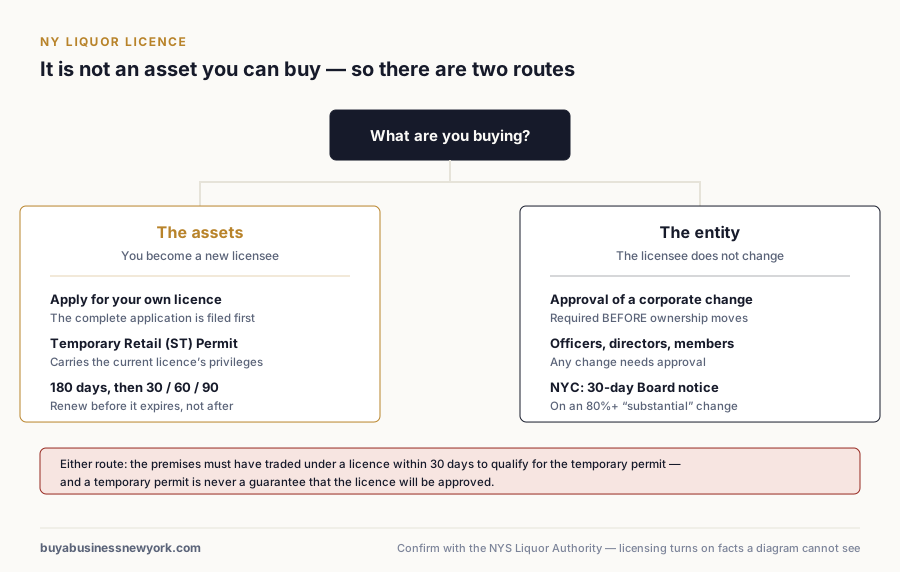
A liquor licence is issued to a licensee, not attached to the premises or sold with the business. Which of the two routes your deal takes — a new application with a temporary permit, or an approved corporate change — follows from whether you buy the assets or the entity, and it moves your realistic closing date by months.
On this page10 sections
- Why the licence does not come with the business
- Route one: you buy the assets
- How long it lasts, and what it costs
- The risk the permit does not remove
- Stock, and how you pay for the next delivery
- Route two: you buy the entity
- The New York City thirty-day clock
- Choosing between the routes
- The clocks running alongside this one
- What to do, in order
Why the licence does not come with the business
Buyers of licensed businesses routinely assume the licence is part of what they are purchasing, in the way the walk-in cooler is. It is not. A retail liquor licence is issued to a specific licensee, and the State Liquor Authority decides who holds one. Nothing in a purchase agreement between you and the seller changes that.
What follows from that is the whole of this page: there are two routes, they run on different mechanics and different clocks, and which one you are on is decided by a structure choice most buyers make before they know the licence depends on it.
Route one: you buy the assets
You apply for your own licence. That application takes as long as it takes, and until it is granted you have no authority to sell alcohol — which for most bars and restaurants means no business at all.
The bridge is the Temporary Retail (ST) Permit. Where the applicant is the purchaser of an existing business, the Authority sets three conditions:[1]
- The premises must have operated under a retail licence within thirty days of the filing. A business that has been dark for six weeks has lost this route.
- A contract of sale or conveyance must accompany the application.
- The permit “gives the applicant the privileges of the current license for the business that is being sold” — you operate under the outgoing licence’s terms, not a fresh set.
Two further conditions apply generally: the temporary application must be preceded or accompanied by a complete application for the retail licence, and the current licence must be surrendered to, placed in safekeeping with, or deemed abandoned by the Authority before a temporary permit can issue.[1] That last one matters commercially: the seller gives up their licence as part of getting you trading, which is a real ask and belongs in the negotiation rather than in a closing-day surprise.
How long it lasts, and what it costs
The permit runs 180 days and may be renewed for a further 30, 60 or 90 days. Renewal must be filed before the existing permit expires — the Authority warns that renewal applications received after expiry may be disapproved. Any conditional approval on the main application expires six months after the letter issues, and no temporary renewal will be processed after that date.[1]
| Fee (per bar) | On-premises beer, grocery or drug store | Any other retail application |
|---|---|---|
| Initial, 180 days | $128.00 | $640.00 |
| Extension, 30 days | $64.00 | $96.00 |
| Extension, 60 days | $128.00 | $192.00 |
| Extension, 90 days | $192.00 | $288.00 |
Fees are payable on filing by personal cheque, certified cheque or money order, and are not refundable.[1] If your permanent application is applying for additional bars, you need a temporary permit — and a separate fee — for each bar.
The risk the permit does not remove
This is the paragraph to read twice. The Authority states that issuing a temporary permit “is NOT a guarantee of approval of the application for the liquor license,” that deficiencies in the permanent application must be satisfied within ten business days of a deficiency letter, and that permits already issued will be cancelled and the permanent application disapproved if they are not. It adds that the Authority is held harmless from any hardship a subsequent disapproval creates for both the purchaser and the seller.[1]
So the temporary permit lets you trade while the real decision is pending. It does not transfer that decision’s risk to anyone else. A buyer who has paid the full price at closing, is operating on a temporary permit, and is then refused a licence owns a business that cannot lawfully do the thing it exists to do.
Stock, and how you pay for the next delivery
Two operational details that catch buyers:
- The seller’s alcohol inventory. If you are buying it from the current licensee, an Application for Liquidator’s Permit with a $36 fee goes in with the temporary permit application. If you are not, you file a signed statement that there is no transfer of alcohol stock.[1] Make sure that matches what the purchase agreement says about inventory.
- Cash terms while on the permit. A temporary permit holder must pay for alcoholic beverages in currency or by cheque. Only a holder who also operates under one or more retail licences, and is not delinquent with wholesalers, may buy on credit.[1] If you modelled supplier credit from the seller’s accounts, that assumption does not hold for your first six months.
Route two: you buy the entity
If the licence sits inside a corporation or LLC and you buy the ownership of that company, the licensee does not change — but the people behind it do, and the Authority regulates that directly.
You must obtain SLA approval before:[2]
- adding or removing an officer or director of a corporation, or a managing member of an LLC; and
- any change in the stockholders or members, or in the stock or ownership interest an existing holder has.
The only carve-out is narrow, and no ordinary buyout fits inside it: no approval is needed where there are ten or more stockholders or members and the change involves less than 10% of the stock or interest and no existing holder below 10% is increased to 10% or more.[2]
Note the word before. This is a prior-approval regime, not a notification one. Closing an equity purchase of a licensed business and filing afterwards is not a paperwork delay; it is a change made without the approval the Authority requires.
The New York City thirty-day clock
For an on-premises licence in New York City, written notice to the Community Board — on the Authority’s form, by certified mail, overnight delivery or personal delivery — is required thirty days before you file the corporate-change application, where the change is “substantial.”[2]
“Substantial corporate change” is defined at 80%: for a corporation, a change of 80% or more of the officers and/or directors, a transfer of 80% or more of the stock, or an existing stockholder obtaining 80% or more. For an LLC, the same 80% tests applied to managing members or ownership interest.[2]
A buyer acquiring a business outright clears 80% comfortably. So on a New York City on-premises deal, add thirty days before the application is even filed, and put the notice date in the closing timetable rather than discovering it when the application is rejected as premature.
Choosing between the routes
| Consideration | Asset purchase | Equity purchase |
|---|---|---|
| What you file | A new licence application, plus a temporary permit to trade | An application to approve a corporate change |
| Can you trade immediately? | Usually yes, on the temporary permit, if the premises traded within 30 days | Not until the change is approved — approval comes first |
| Who holds the licence | You, on a new licence | The same entity, under new ownership |
| Seller must surrender the licence | Yes — surrender, safekeeping or abandonment before the permit issues | No — the licence stays with the entity |
| NYC extra step | Municipal or Community Board notification rules apply to the licence application | 30-day Community Board notice before filing, on a substantial change |
| What you inherit | A fresh licence — and none of the entity’s history | The entity’s full history, including any disciplinary record |
The last row is the one that decides plenty of these deals. An equity purchase keeps the licence intact and avoids the temporary-permit dance, but you take the company as you find it — including any pending disciplinary matter. The temporary permit application itself asks whether there are pending disciplinary matters against the seller’s location, the seller’s principals and the buyer’s principals,[1] which tells you how seriously the Authority takes the question. Diligence the licence history as carefully as the financials, and read the asset versus equity guide for everything else the structure decides.
The clocks running alongside this one
Licensing is not the only approval on your closing date, and the others do not wait for it:
- Sales tax. A Certificate of Authority cannot be transferred or assigned, and you must register at least 20 days before you begin business.[3] On an asset purchase that filing has to happen during diligence.
- Bulk sale. Buying the assets of a New York business can attach the seller’s unpaid sales tax to you through successor liability unless the notice process is followed.[4] See the bulk-sale guide.
- The lease. Landlord consent is usually the slowest consent in a licensed-premises deal, and a licence is worth little without the right to occupy. See lease assignment.
Map all four on one timetable at the letter of intent stage. They have different lead times and only one of them — the lease — is usually on anybody’s critical path by default.
What to do, in order
- Establish which route the deal is on before you agree structure. If the licence is a material part of what you are buying, it belongs in the structure conversation.
- Confirm the premises is currently trading under its licence and has been within the last thirty days. If the business is dark, the temporary-permit route may already be gone.
- Diligence the licence itself — its class, its conditions, any pending disciplinary matter against the location or the principals, and whether the method of operation you intend matches what is licensed.
- File the complete licence application first, then the temporary permit; the Authority requires the permit application to be preceded or accompanied by a complete licence application.
- On a New York City equity deal, serve the Community Board notice thirty days before filing.
- Write it into the agreement. Make licence approval a closing condition, decide expressly who bears the risk if the permanent application is refused, and agree what happens to the price if the business trades on a temporary permit and then cannot continue.
None of this is legal advice, and licensing turns on facts this page cannot see — the licence class, the premises, the municipality, the principals. Confirm your specific situation with the State Liquor Authority and a New York licensing attorney before you rely on any of it.
Frequently asked questions
Can I just take over the seller’s liquor licence?
No. The licence belongs to the licensee, not to the premises or the business. Buying the assets means applying for your own licence; buying the entity that holds the licence means obtaining the Authority’s approval of the corporate change before the ownership moves. Either way the Authority decides, and either way it takes time you have to build into the deal.
Can I keep the doors open while my application is pending?
Often yes, through a Temporary Retail (ST) Permit. Where you are purchasing an existing business, the premises must have operated under a retail licence within thirty days of the filing, a contract of sale or conveyance must accompany the application, and the current licence must be surrendered, placed in safekeeping or deemed abandoned before the permit can issue. The permit gives you the privileges of the licence being sold, runs 180 days, and can be renewed for a further 30, 60 or 90 days.
What happens if my permanent licence application is refused?
The Authority is explicit that issuing a temporary permit “is NOT a guarantee of approval” of the licence application, and that it is held harmless from any hardship a later disapproval causes to purchaser and seller alike. Deficiencies in the permanent application must be cured within ten business days of a deficiency letter, or the temporary permit is cancelled and the permanent application disapproved. Price that risk before closing, not after.
I am buying the company rather than the assets. Does that avoid the licensing problem?
It changes it rather than avoiding it. You must obtain SLA approval before any change in the stockholders or members, or in the stock or interest an existing holder has, and before adding or removing an officer, director or managing member. The only carve-out is narrow: ten or more stockholders or members, a change of less than 10%, and no existing sub-10% holder rising to 10% or more. Prior approval means before, not after.
Does New York City add anything?
Yes. For an on-premises licence in New York City you must give your Community Board written notice, on the Authority’s form, thirty days before filing a corporate-change application where the change is “substantial” — broadly a change of 80% or more of officers, directors or managing members, or a transfer of 80% or more of the stock or ownership interest. Notice is by certified mail, overnight delivery or personal delivery. On a straightforward buyout that threshold is met, so build the thirty days into the timetable.
Do I need a separate permit for each bar?
Yes, where you are applying for additional bars in the permanent application. The Authority requires a Temporary Retail Permit for each bar, with a separate fee for each. A multi-bar venue is therefore several filings and several fees, not one.
Can I buy the seller’s alcohol stock?
Only with the right paperwork. If you are purchasing the alcoholic beverages from the current licensee, an Application for Liquidator’s Permit with a $36 fee is required when you submit the temporary permit application. If you are not, you must submit a signed statement that there is no transfer of alcohol stock. Buyers routinely overlook this and find the inventory line in the purchase agreement does not match what the Authority has been told.
What does the temporary permit change about how I buy alcohol?
A temporary permit holder must pay for alcoholic beverages in currency or by cheque. The exception is a permit holder who also holds one or more retail licences, is operating under them, and has not been reported delinquent with wholesalers — they may buy on credit. If you were modelling supplier credit terms from the seller’s accounts, adjust the working-capital assumption for the temporary period.
Sources cited on this page
Every mutable number on this page — program caps, tax rules, thresholds, filing deadlines — traces to one of these primary sources. Rules change; check the source before you act on the number.
- 1 New York State Liquor Authority. Form -35, Application for Temporary Retail (ST) Permit. https://sla.ny.gov/system/files/documents/2026/03/temporary-retail-st-permit_02262026_0.pdf
- 2 New York State Liquor Authority. Handbook for Retail Licensees. https://sla.ny.gov/system/files/documents/2025/08/stateliquorauthority-retaillicenseeshandbookrevised7-31-2025.pdf
- 3 NYS Department of Taxation and Finance. Tax Bulletin ST-360: How to Register for New York State Sales Tax. https://www.tax.ny.gov/pubs_and_bulls/tg_bulletins/st/how_to_register_for_nys_sales_tax.htm
- 4 NYS Department of Taxation and Finance. Bulk sales. https://www.tax.ny.gov/pubs_and_bulls/tg_bulletins/st/bulk_sales.htm
Educational only — not legal, tax, lending, or investment advice. Confirm specific rules, rates, and forms with the relevant New York State agency, attorney, CPA, lender, or insurer before acting. See the editorial policy and methodology for how sourcing and review work.