
Free calculator
Seasonality stress test
Monthly revenue — from the target's own records
- Annual revenue
- —
- Best quarter / worst quarter
- —
- Season concentration
- —
- DSCR on the year
- —
- DSCR on the trough quarter
- —
- Months below breakeven
- —
- Cash low point
- —
Arithmetic on figures you supply. It models revenue seasonality against a flat monthly fixed cost and a flat debt service, which is a simplification — costs move with volume in most businesses, and some debt amortises unevenly. It does not model tax, capital expenditure, or a working-capital target the seller delivers. Use it to size the problem, not to replace a lender's own analysis.
Why the annual figure is the wrong test
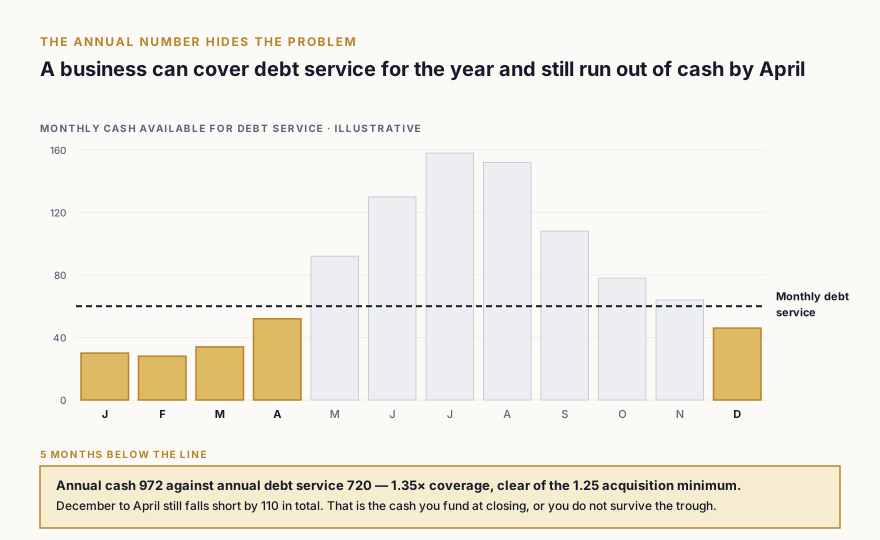
Underwriting a seasonal business on its annual total is the most reliable way to buy one you cannot operate. The year works. February does not, and February arrives first.
Three numbers matter and none of them is visible in a trailing-twelve-month summary:
- The trough quarter. Annualise your worst three months and ask whether the business covers its debt service at that run rate. If it does not — and for a genuinely seasonal business it usually does not — you are relying on the season to catch up, which is fine as long as you can fund the wait.
- The cash low point. Run the months in order, let the deficits accumulate, and find the deepest the balance goes. That is the working capital the business actually needs, and it is almost always larger than a buyer expects.
- Months below breakeven. How many months the business loses money, and consecutively. Two loss-making months in a row is a cash-flow inconvenience; five is a financing plan.
Getting the inputs right
Use the target's own monthly revenue, from its records rather than a summary. Ask for 36 months and run the worst of the three years, not the most recent — a mild winter or an unusually strong season flatters a single year, and you are buying the business for considerably longer than that.
The gross margin matters as much as the shape. A quiet month is survivable only to the extent revenue covers the fixed costs that run whether or not anyone comes through the door. A low-margin business with a deep trough is in much more trouble than a high-margin one with the same revenue curve.
For debt service, use principal and interest on all business debt including the new acquisition loan, which is how SOP 50 10 8.1 defines it [1] — not just the acquisition loan in isolation.
Where this bites in New York
Seasonality is not an edge case here. Across the Nassau-Suffolk metro division, leisure and hospitality employment runs 121.2 thousand in February against 147.8 thousand in July — a swing of roughly 22%, and sharper still on the East End itself. The Catskills, the Finger Lakes, the North Fork and the Adirondack markets all carry a version of it, and so do industries that look year-round until you check: car washes in road-salt country, landscaping, lodging, and any business leaning on an academic calendar.
The corollary is that seasonality is systematically mispriced by buyers who only look at annual totals. A buyer who underwrites the trough properly is confident where others are guessing, and can bid accordingly.
What to do with the answer
If the cash low point is large, that is a number for the purchase agreement rather than a surprise for month four. Take it to the working capital calculator and turn it into a target the seller delivers at closing — which is far easier to negotiate in the letter of intent than after diligence.
If the trough coverage is thin, the levers are price, amortisation length, and how much of the injection you keep back as reserve rather than putting into the deal. All three are easier to move before you sign.
Frequently asked questions
Why not just use the annual figure?
Because your loan payment does not take the winter off. A trailing-twelve-month cash flow figure averages the strong months with the dead ones, and a business that comfortably covers its debt service across the year can still run out of cash in February. The annual number tells you whether the deal works; the trough tells you whether you survive to find out.
What is the cash low point?
The deepest the running cash balance goes if you start at zero and let the months accumulate. It is the working capital the business needs to get through its quiet period without further funding, and it is the number most buyers of seasonal businesses discover too late. Fund it at closing or you are borrowing at the worst possible moment.
Which months should I enter?
The target's actual monthly revenue, from its own records, for the most recent full twelve months. Ask for 36 months if you can get them and run the worst of the three years rather than the most recent — a mild winter or a strong season flatters a single year, and you are buying the business for longer than that.
What DSCR do I need to clear?
On a first acquisition SBA requires debt service coverage of at least 1.25, measured on the last fiscal year-end or a two-year average, and at least 1:1 on a global basis. That is a requirement rather than a lender preference. Many lenders want more on top. A seasonal business that only clears 1.25 on the annual figure and falls well below it in the trough is a harder credit than the annual number suggests.
Does contribution margin matter more than revenue here?
Yes. A quiet month is only survivable to the extent revenue covers the fixed costs that run regardless. That is why this asks for a gross margin rather than working on revenue alone — a low-margin business with a deep trough is in far more trouble than a high-margin one with the same revenue shape.
Sources cited on this page
Every mutable number on this page — program caps, tax rules, thresholds, filing deadlines — traces to one of these primary sources. Rules change; check the source before you act on the number.
- 1 U.S. Small Business Administration. SOP 50 10 8.1 — Lender and Development Company Loan Programs. https://www.sba.gov/document/sop-50-10-lender-development-company-loan-programs
Educational only — not a valuation, a loan pre-approval, or a lender's number. Confirm specific rules, rates, and forms with the relevant New York State agency, attorney, CPA, lender, or insurer before acting. The formulas behind this tool are documented on the methodology page.