
Tax and structure guide
Purchase price allocation and Form 8594
Two buyers can pay the same price for the same business and end up with materially different after-tax outcomes, entirely because of how one schedule in the purchase agreement was written. Allocation is negotiable, it is binding once agreed in writing, and it is routinely given away by buyers who did not know it was on the table.
On this page8 sections
What allocation is, and when it arises
You agree to buy a business for $900,000. That is one number. But you are not buying one thing — you are buying a van, some equipment, the inventory, the customer list, a covenant not to compete, and whatever is left over that makes it a going concern. The tax code needs to know how much of the $900,000 went to each, because each is treated differently.
This only arises in an asset purchase. Section 1060 applies to an "applicable asset acquisition," which it defines as a transfer of assets constituting a trade or business where the transferee's basis is determined wholly by reference to the consideration paid [2] . In a straightforward stock or membership-interest purchase you take the interests and the entity keeps its existing basis, so there is no Form 8594 and no allocation exercise. Which structure you are in is decided earlier — see our asset versus equity guide.
The IRS instructions define the threshold generously: a group of assets makes up a trade or business "if goodwill or going concern value could under any circumstances attach to such assets" [1] . Most small-business acquisitions clear it comfortably.
The seven classes and the residual method
Allocation is not a free-form negotiation across all assets at once. The residual method fills the classes in order, and each class other than the last is capped at fair market value. 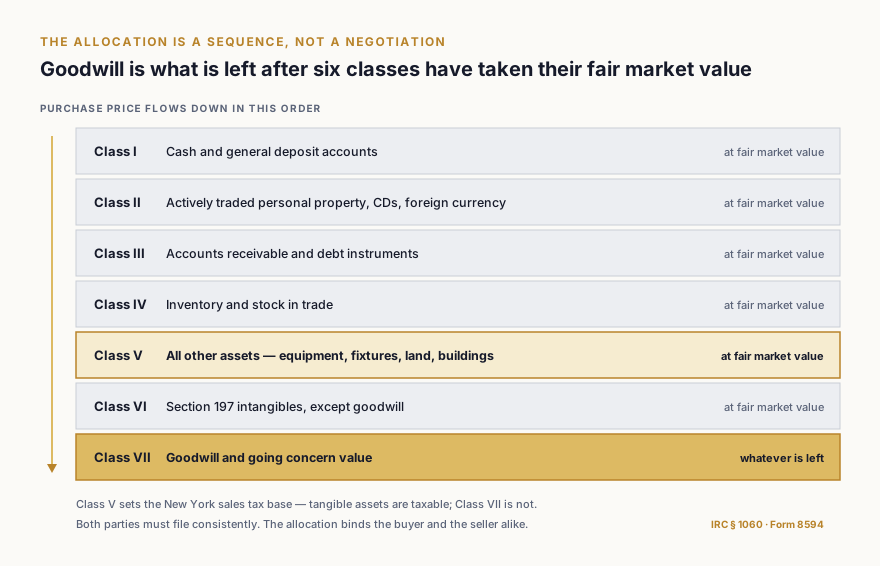
| Class | What it contains | Buyer's tax treatment, broadly |
|---|---|---|
| I | Cash and general deposit accounts, including savings and checking, other than certificates of deposit | No deduction. Dollar for dollar |
| II | Actively traded personal property, certificates of deposit, foreign currency; examples given are U.S. Government securities and publicly traded stock | Rarely present in a small deal |
| III | Assets the taxpayer marks to market at least annually, and certain debt instruments | Rarely present |
| IV | Stock in trade and inventory — property held primarily for sale to customers in the ordinary course | Cost of goods sold as it turns |
| V | Everything not in another class. The instructions note that furniture and fixtures, buildings, land, vehicles and equipment are generally Class V | Depreciation, over relatively short lives. Land is the exception — no depreciation |
| VI | All section 197 intangibles except goodwill and going concern value — workforce in place, business books and records, operating systems, customer lists, covenants not to compete | Amortised over 15 years |
| VII | Goodwill and going concern value. The residual class | Amortised over 15 years |
The mechanics, from the instructions [1] : reduce the consideration by the Class I assets, then allocate the remainder to Class II, then III, IV, V and VI in that order, within each class in proportion to fair market values. Whatever is left lands in Class VII. Critically, "the amount allocated to an asset, other than a Class VII asset, cannot exceed its fair market value on the purchase date."
That cap is what stops the negotiation being arbitrary. You cannot simply decide to call $400,000 of a $900,000 price "equipment" because the depreciation suits you. If the equipment is worth $150,000, $150,000 is the ceiling. The room to negotiate lies in genuine valuation judgement and in the classes where reasonable people differ — not in inventing numbers.
Why the two sides want different answers
This is the part worth understanding before you sit down to negotiate, because a seller's advisers will already know it.
| Allocated to | Buyer generally wants | Seller generally wants |
|---|---|---|
| Class V — equipment, vehicles, fixtures | More. Depreciation over a few years beats amortisation over fifteen. The deduction arrives while you are still paying the acquisition loan | Less. Depreciation recapture on assets already written down can turn the gain into ordinary income taxed at higher rates |
| Class IV — inventory | Neutral to favourable; it turns into cost of goods sold quickly | Less. Ordinary income |
| Class VI — customer lists, non-compete, workforce | Fifteen-year amortisation. Better than nothing, worse than equipment | Mixed. A covenant not to compete is typically ordinary income to the seller, which they will resist |
| Class VII — goodwill | Less, all else equal — fifteen years is a long wait | More. Typically capital gain, generally the seller's best outcome |
The headline tension is therefore equipment versus goodwill, and it is a genuine economic conflict rather than a technicality. It is also, on a small acquisition, frequently worth five figures to each side. That is why it deserves to be traded rather than conceded, and why it belongs in the letter of intent rather than being discovered in a draft agreement three days before closing.
The one provision that changes the negotiation. Section 1060(a): "If in connection with an applicable asset acquisition, the transferee and transferor agree in writing as to the allocation of any consideration, or as to the fair market value of any of the assets, such agreement shall be binding on both the transferee and transferor unless the Secretary determines that such allocation (or fair market value) is not appropriate" [2] . In writing, and it binds. Verbally, and it does not.
The New York consequence federal guidance omits
Every national article on allocation stops at the federal analysis, and in New York that is half the picture.
New York sales tax applies to tangible personal property transferred in a bulk sale [3] . The equipment, furniture, fixtures and vehicles that make up your Class V allocation are precisely that property. So the number you negotiate for federal depreciation purposes is also the base on which a New York sales tax liability is computed at closing.
The buyer who reads only federal guidance pushes hard for a high equipment allocation, wins the point, and then discovers the state tax cost of having won it. In New York City the combined rate is 8.875%; in Nassau 8.625%, Suffolk 8.75%, Westchester 8.375% outside Yonkers. On a $200,000 equipment allocation in Suffolk that is $17,500 payable now against a depreciation benefit spread over several years.
The allocation and NY tax modeller runs both sides of this at your actual county rate, including what moving $50,000 between goodwill and equipment costs and buys.
It is not that the high allocation is wrong — often it is still right. It is that the trade has to be modelled with both taxes in it, and that the sales tax cost is a legitimate argument for the buyer to make when the seller pushes value toward equipment for their own reasons. Get your accountant to run it both ways before you agree the schedule.
Separately and independently, the bulk-sale notification obligation applies: notify the Department at least 10 days before taking possession or paying, or you can be held liable for the seller's unpaid sales tax [4] . Our bulk-sale guide covers the process; do not conflate the two — one is about tax on the assets you bought, the other is about tax the seller failed to pay.
Filing: both sides, same numbers
The instructions are clear that "generally, both the purchaser and seller must file Form 8594 and attach it to their income tax returns" when a group of assets constituting a trade or business is transferred and the purchaser's basis is determined wholly by the amount paid — and that this applies whether the assets constitute a trade or business in the hands of the seller, the purchaser, or both [1] .
- Part I takes the other party's name, address and taxpayer identification number. You are required to enter it — so collect the seller's TIN at closing, not in April.
- Part II is the original statement: fair market value and allocated price by class. Note that Classes VI and VII are reported combined on line 4.
- Line 6 must be completed by both. Where the price is contingent, assume the contingencies are met and use the highest possible amount; if the maximum cannot be determined, state how it will be computed and over what period.
- Part III is the supplemental statement, filed on a new Form 8594 for each year in which consideration increases or decreases.
- Penalties. Filing an incorrect Form 8594 by the due date without reasonable cause may attract penalties under sections 6721 through 6724.
Two returns describing the same transaction differently is the mismatch this form is designed to reveal. Agree the schedule, attach it to the purchase agreement, and give the same numbers to both accountants.
When the price changes afterwards
Working-capital true-ups, escrow releases and rebates all move the consideration after closing, and the allocation has to move with them. The instructions require an increase to be allocated first to Class I and then through the classes in order. If the change happens in the same tax year as the purchase, treat it as having occurred on the purchase date; if later, account for it in the year it occurs and file a supplemental Form 8594 [1] .
This is a good reason to make sure whoever prepares your return knows a true-up happened. It is a common quiet omission.
What to actually do
- Raise it in the LOI. One line — that the parties will agree an allocation consistent with section 1060 and attach it as a schedule — costs nothing and stops the seller assuming the point is theirs. See the LOI guide.
- Get real fair market values for the tangible assets during diligence. You need them anyway for insurance and lending, and the Class V cap makes them the anchor of the whole exercise.
- Have your accountant model at least two splits, with federal depreciation, seller-side recapture and New York sales tax all in the model. Bring the output to the negotiation.
- Watch the covenant not to compete. It is a Class VI section 197 intangible and it is typically ordinary income to the seller. Sellers resist value here; understand what you are giving up if you agree to shrink it, since the covenant's value and its enforceability are related questions.
- Put the agreed schedule in the purchase agreement, signed. Section 1060(a) binds a written agreement; it does nothing for an understanding.
- Collect the seller's TIN at closing — Form 8594 requires it and sellers become hard to reach.
- Tell your accountant about every post-closing adjustment so the supplemental statement gets filed.
Scope and limits
This describes the general framework from the Form 8594 instructions (Rev. November 2021) and the text of section 1060. It is not tax advice and it does not address the many situations that change the analysis: real property in the transaction, section 1031 exchanges, partnership interests under section 1060(d), related-party transfers, installment reporting, or state income tax treatment. Depreciation lives and recapture rules depend on the specific assets and on elections available in the year of purchase. Allocation is one of the few parts of a small acquisition where an hour of a good accountant's time reliably pays for itself — buy the hour.
Frequently asked questions
What is purchase price allocation?
In an asset sale, the single agreed price has to be divided among the individual assets you bought. That division determines your depreciation and amortisation deductions as buyer, and the character and amount of the seller's gain. Section 1060 requires it to be done by the residual method across seven asset classes, and both parties report it to the IRS on Form 8594.
Is the allocation negotiable?
Yes, and it is one of the most valuable things in the agreement that buyers leave on the table. Section 1060(a) provides that where the transferee and transferor agree in writing as to the allocation, that agreement is binding on both — unless the Secretary determines it is not appropriate. So it is negotiable, it is worth negotiating, and it has to be in writing to bind.
Why do the buyer and seller want different allocations?
Because the same dollar is taxed differently on each side. A buyer generally prefers value in equipment and other Class V assets, which depreciate over a few years, over goodwill, which amortises over 15. A seller often prefers goodwill, which is typically capital gain, over equipment, where depreciation recapture can produce ordinary income. The tension is real, which is why it should be priced rather than conceded.
Do both sides have to file Form 8594?
Generally yes. The instructions say both the purchaser and seller must file Form 8594 and attach it to their income tax returns when a group of assets constituting a trade or business is transferred and the purchaser's basis is determined wholly by the amount paid. Filing an incorrect form by the due date without reasonable cause can attract penalties under sections 6721 to 6724.
What happens if the two sides file different numbers?
Two returns reporting the same transaction differently is exactly the mismatch the form exists to surface. It invites examination of both parties, and neither has the protection of a written agreement to point to. Agreeing the allocation in the purchase agreement and attaching the schedule is cheaper than arguing about it later.
Does the allocation affect New York sales tax?
Yes, and this is the part most federal guidance omits. New York sales tax applies to tangible personal property transferred in a bulk sale. The amount you allocate to Class V — equipment, furniture, fixtures, vehicles — is the base that tax is computed on. A buyer who pushes value into equipment for the federal depreciation benefit is also increasing a New York sales tax bill payable at closing.
Does any of this apply to a stock purchase?
Not in the same way. Section 1060 applies to an applicable asset acquisition — a transfer of assets constituting a trade or business where the buyer's basis is determined by what was paid. In a straightforward stock or membership-interest purchase you take the interests, and the entity keeps its existing asset basis, so there is no Form 8594. Certain elections can change that; ask your accountant before assuming.
What if the price changes after closing?
You reallocate. The instructions require the seller or purchaser to allocate an increase or decrease in consideration among the assets, in class order starting at Class I. Where it happens in the same tax year as the purchase, treat it as occurring on the purchase date; otherwise account for it in the year it occurs, and file a supplemental Form 8594 using Part III.
Sources cited on this page
Every mutable number on this page — program caps, tax rules, thresholds, filing deadlines — traces to one of these primary sources. Rules change; check the source before you act on the number.
- 1 Internal Revenue Service. Instructions for Form 8594, Asset Acquisition Statement Under Section 1060. https://www.irs.gov/pub/irs-pdf/i8594.pdf
- 2 Cornell Law School, Legal Information Institute. 26 U.S. Code § 1060 — Special allocation rules for certain asset acquisitions. https://www.law.cornell.edu/uscode/text/26/1060
- 3 NYS Department of Taxation and Finance. Tax Bulletin ST-360: Purchasers' Obligations to Pay Sales Taxes (Bulk Sales). https://www.tax.ny.gov/pubs_and_bulls/tg_bulletins/st/purchasers_obligations_to_pay_sales_taxes.htm
- 4 NYS Department of Taxation and Finance. Bulk sales. https://www.tax.ny.gov/bus/st/bulk_sales.htm
Educational only — not legal, tax, lending, or investment advice. Confirm specific rules, rates, and forms with the relevant New York State agency, attorney, CPA, lender, or insurer before acting. See the editorial policy and methodology for how sourcing and review work.